Homer's Travels: Ethiopia
Showing posts with label Ethiopia. Show all posts

Monday, January 16, 2023

Travel Magnets - 2022 Fall Travels Edition

Seventy-Five.  That is the number of travel magnets we purchased on our travels through Israel, Turkey, Egypt, and Ethiopia.  It was a long trip with many things to see but that number still feels a bit excessive, even for me.  There are also some accidental duplicates (i.e. two magnets commemorating the same place) but that really doesn't account for the number.  There were just so many places to commemorate.

The magnets are a mix of generic and unique.  I always prefer the handmade one over the generic photo magnet but handmade ones can be hard to find. Here are a few of my favorite ones:

Jars similar to the ones the dead sea scrolls were found in.
A hand painted picture of a Gulet.
I hated my camel ride but I like this camel magnet.
The face of an Ethiopian woman.
The Travel Magnet folder now has six hundred and seven magnets.  We are once again running out of space to display them all.  I will have to add more metal panels to the pantry hall walls to display them all.

I've always had trouble photographing the 3-D magnets.  The flat ones can be scanned on our flatbed scanner.  The 3-D ones always had issues with weird shadows.  I fixed it this time by purchasing a cheap ring light.  The one I bought is a piece of sh!t but it works for me.

You can see all our magnets in the Travel Magnets tab at the top of the blog.

Sunday, January 01, 2023

Best Photo Of 2022

I took more pictures in 2022 but that was mostly a result of our fall travels.  When you visit four 'new' countries with so much to photograph it is hard not to take a few.  The rest of the year, when we weren't traveling, I took very few photos that grabbed me.

In 2022 I marked twenty photos as 'favorites'.  Of the photos, only two were not taken during our fall travels - two photos from my doomed Appalachian Trail hike.  Three were taken in Israel.  Eight were taken in Turkey.  One was taken in Egypt (this surprised and disappointed me).  Six were taken in Ethiopia.

My favorite photo of the year was an impromptu photo, taken through the windshield of our van, on the way out of Dire Dawa, Ethiopia.  I've wondered why I like it.  It doesn't capture some piece of history, nature, or art.  It captures an ordinary moment in time - a moment of life - in another place.  I suppose that is why I like this photo:

"Market Street"
by Bruce H.
(Taken the 9th of October, 2022)
I hope you had a happy and safe New Year's Eve.  2022 was, in general, a better year than I'd expected.  I hope this trend continues into 2023.  We have some travels planned this year and my camera will be with me to capture it all along the way.

Friday, December 23, 2022

2022 Fall Travels, Part Four - Ethiopia - The Karo, The Hamer, The Dassanech, And The Mursi Tribes

A man of the Karo tribe.
The Buska Lodge was … interesting.  The huts were similar to the Paradise Lodge's bungalows but they were definitely more primitive.  There were two single beds opposite of each other.  The one thing missing here was electricity.  Power was only available for a few hours in the morning and a few hours at night.  After 11:00PM it was lights out.  It was also warmer in southern Ethiopia and we kept cool in our huts with floor fans.  Unfortunately no electricity = no fans.  So when you woke up in the middle of the night it was hot and a bit sweaty.  Fortunately we were out and about most of the day, the food was good, and there was beer for the Wife.

Over the next three days we visited four tribes.  The first was the Karo.  Their village was on a highlands overlooking the Omo River.  Our guide lined up the women and then the men so we could take pictures (another awkward moment for me).  They demonstrated their face painting art.  As we left we passed a raucous group dividing up the grain harvest.

The next was the Dassanech tribe.  We visited their village of domed homes that are made of wood and mud but are more commonly built with tin now.  We saw the differences between the tribes and how their customs vary.  I purchased a handmade crocodile tooth necklace here.

Karo women distributing the harvest.

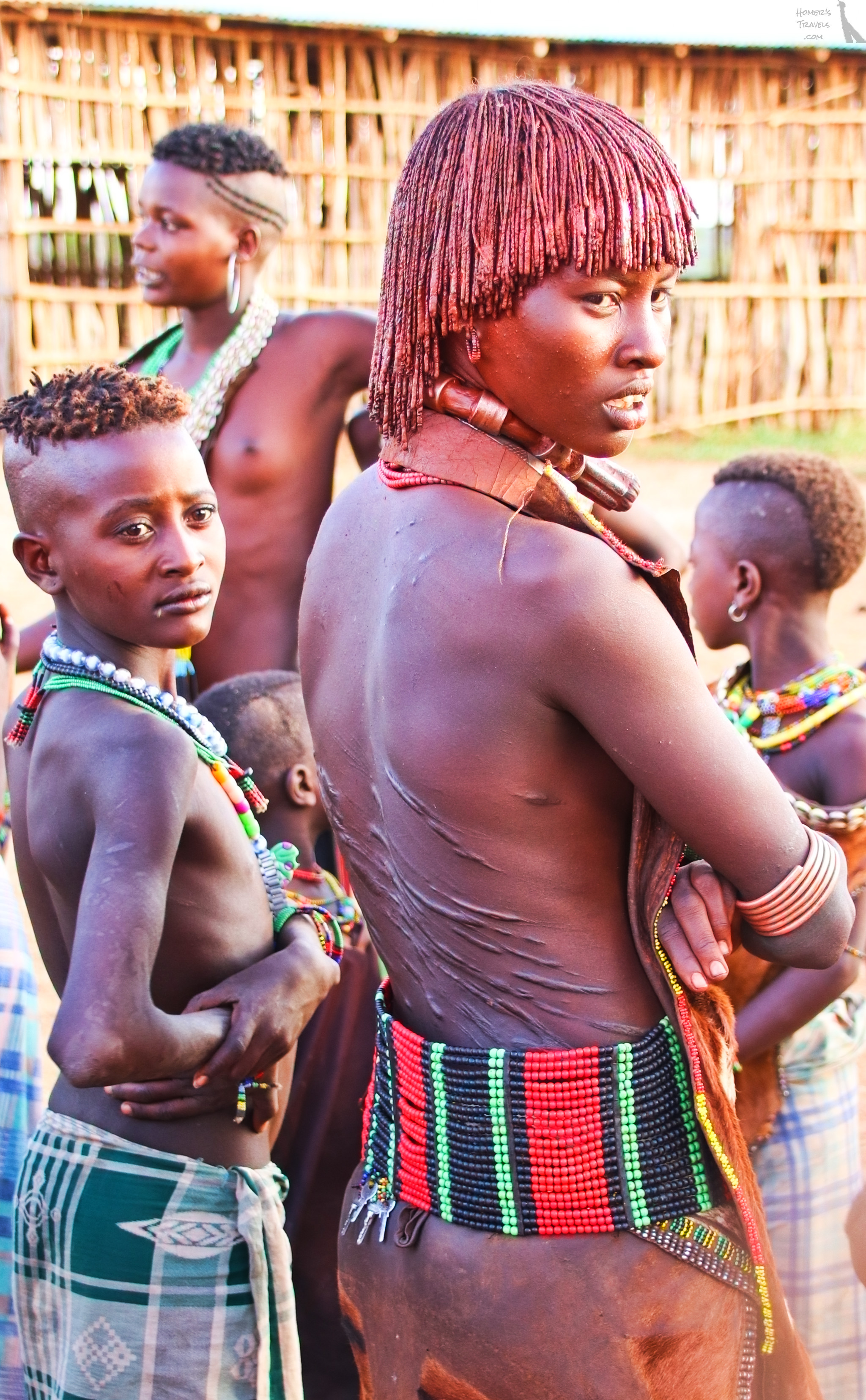
Whip scars proving
their devotion.
The third was the Hamer tribe.  This one  was very interesting but a bit disturbing.  First, when a couple marries the woman is kept in a hut for three months never venturing outside.  Food and drink are brought to her during this period and she does not have to work for her tribe.  With encouragement from our guide, and permission from the tribal elder, she was brought out where we could see her.  She did not look happy or comfortable at all as we took pictures.  It was like a reluctant sideshow act and the Wife and I felt this was very wrong.  Also disturbing was the custom of some young women to allow themselves to be whipped to prove their devotion to their families.

At the Hamer village I learned my name in their language was "Hello Photo".

A Hamer girl.
We ended up at the Eco-Omo Safari Lodge which was a step above the Buska Lodge (but not even close to the Paradise Lodge).  We could have slept in tents but they put us in newer lodge rooms which was probably for the better.

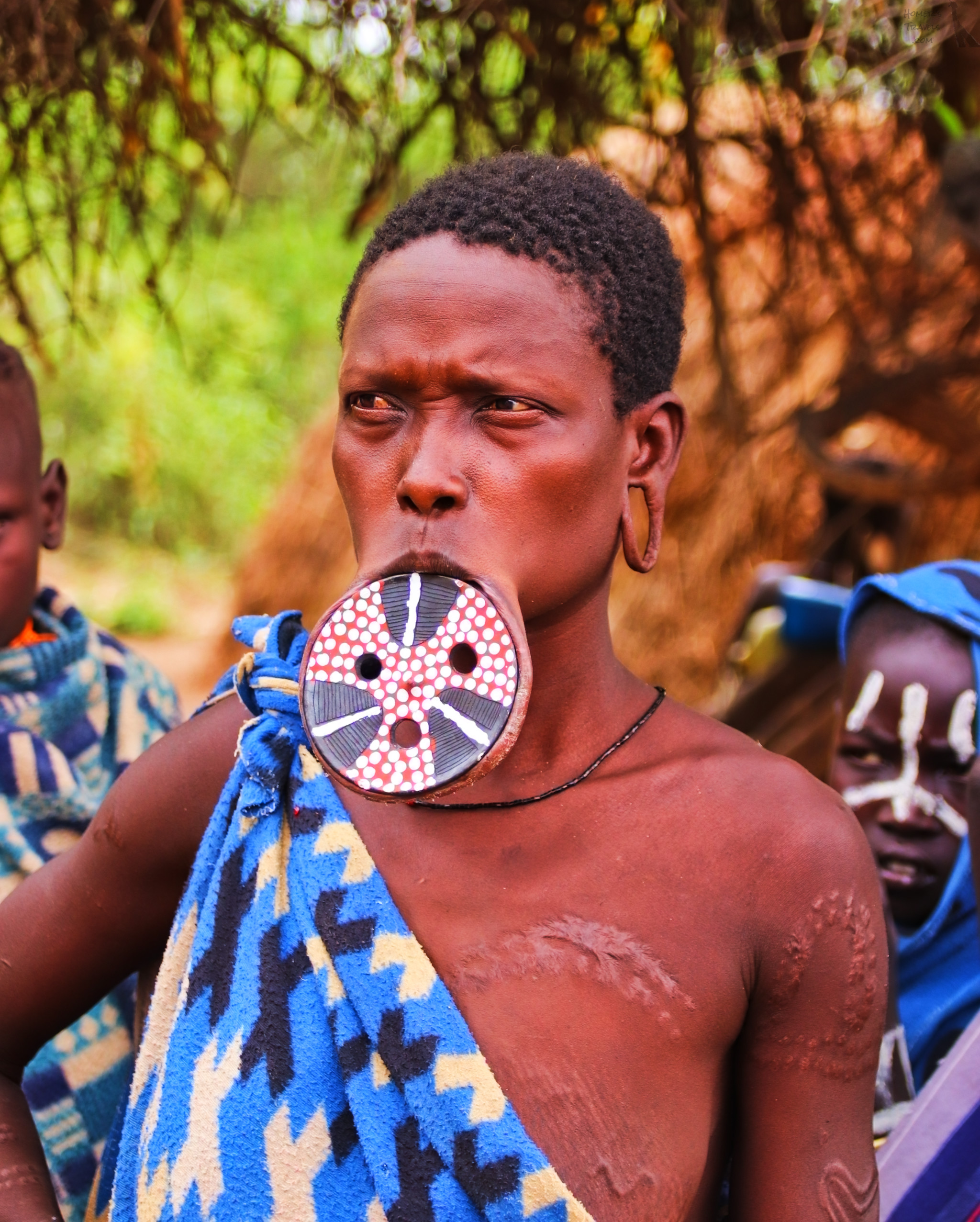
The last tribe visited was the Mursi.  The Mursi women wear the plates in their lower lips and large disks in their earlobes.  It is believed they started doing this to make themselves ugly and undesirable to slave traders.  We learned how the clay disks are made, how the lower lip is cut and stretched, and how the bottom front four teeth are knocked out so the disk fits.  The Wife left the village with twelve of the lip disks.

A Mursi woman with her lip plate.
We returned to Addis Ababa the next day.  We spent the last day  visiting the places that we couldn't visit way back on our first day.  We drove up to Mount Entoto to take in the sweeping view of Addis Ababa.  We then visited the National Museum.  Here we saw art and history including the bones of Lucy (replicas actually ... they are too precious to have the real ones out in public).  The newly renovated wing of the museum is very well done.

In the afternoon we visited an awesome store for some last minute shopping.  We ended up with a lot of treasures this trip, many from Ethiopia.  Our only rule is that we have to be able to carry them.  I will write about them in a future post.

Artwork at the National Museum.
In the evening we had a goodbye dinner at a traditional restaurant that offered live local music on stage. The food was a bit too traditional (i.e. spicy hot) for my taste but they did add some less spicy options that were to my liking.

Ethiopia was an unexpected place for me.  I'd come here with zero expectations and was surprised every day by the things I saw and experienced.

Our adventure was over.  I never really felt like I was ready to come home until the last week.  I think it is not the length of time you travel that makes you homesick but the shortening of the time left at the end that ignites those feelings.

I still have a few more 2022 Fall Travels posts in me but they will have to wait until the new year.

Pictures can be found in my Ethiopia 2022-10 Google Photos album.

Monday, December 19, 2022

2022 Fall Travels, Part Four - Ethiopia - Paradise Lodge, Lake Chamo, The Dorze, And The Konso

We left Harar and flew to Arba Minch.  This was a travel day and we ended our day at the Paradise Lodge.  This place came close to living up to its name.  The lodge is located on the edge of a ridge with spectacular views of lake Abaya, lake Chamo, and the jungle parkland in between.

Lake Abaya and the forest view of the Paradise Lodge. 
A few days before arriving at the lodge our guide mentioned a great masseuse at the Paradise lodge.  The Wife and I, another of our tour group, and our guide all booked massages the day of our arrival.  I'd expected the usual Swedish massage.  Instead it was a deep tissue massage … my first.  A deep tissue massage is aggressive and this masseuse knew exactly where  the knots in my muscles were and she aggressively went after them.  I cringed a few times at just how aggressive she was.  As I left the spa I warned the Wife and suggested she ask for a less aggressive massage.  I returned to our 'hut' (our hut had a real floor, plastered walls, windows and sliding doors, a king size bed, electricity, and running water … more a hotel room than a traditional hut) and sat out on our back veranda admiring the view.  All of a sudden I felt the delayed reaction of the massage (I think the adrenaline wore off) and my body just relaxed.  I have never felt so relaxed.  The Wife returned an hour later.  This was her first real massage and she loved it.

A goliath heron.
While I was waiting for the Wife to return our hut was visited first by Momma warthog and her two young'uns and later by Poppa warthog.  I was so relaxed it took me a while to get my camera and take a picture of Poppa.
Poppa warthog.

The next day we went to lake Chamo and boarded a motor boat.  The level of the lake was very high and the dock and concession stands were underwater.  We had to walk on a narrow log to get to the boat.  The boat took us out on the lake (This was boat ride number five if I'm counting right) where we saw fisherman fishing from small rafts, birds, hippopotami lounging in the shallows of the lake, and crocodile sunning themselves on an island.  The crocodiles leave their mouths open so birds will come in and clean out any parasites in their mouths.

A crocodile sunning himself with his mouth open.
After lunch at the lodge we drove to Chencha to visit the Dorze people.  These people live in domed houses that look like elephant's head.  The tribe once hunted elephants but over the years the elephants had moved to other locations.  We learned how the homes are built, how termites erode the base of the house slowly shrinking the house, and how the smaller eroded houses are used as kitchens or storage huts.
Dorze "elephant" house.

We then learned how the tribe cultivates the false banana and how they use all parts of the plant for weaving, food, and drink. 

This was followed by a dance and singing demonstration.  This is the part of visiting tribes that bothers me.  It feels like we are watching circus animals performing instead of people actually celebrating their culture.  The only consolation is our tour company pays the tribe for the our visit and this helps them continue their way of life.

On the way out of town we visited the town market where I learned that my name was apparently "Hello Money".  At least that is what all the kids called me.

The next day we reluctantly left the Paradise lodge and drove into the highlands to visit the Konso tribe.  This tribe build their villages on hillsides and surround them with walls.  The location and walls make it easier for them to defend their village from enemies or at least it used to.  As the village grows new walls are built. The village we visited had three concentric walls. The inner walls are hundreds of years old as are the stone terrasses the Konzo people farm on. In the village we learned how they grew coffee, how they built generation poles (a new pole is added for each generation living in the village), and about the stones used to test if you had reached manhood (I was not a man as I could not lift it at all and to be a man you had to lift it and toss it over your shoulder).

Older Konzo men play games and take care of the children as the younger adults work.
At the end of the day we ended up at the Buska lodge in Turmi.  Our adventure in southwestern Ethiopia would continue.

Pictures can be found in my Ethiopia 2022-10 Google Photos album.

Friday, December 16, 2022

2022 Fall Travels, Part Four - Ethiopia - Harar

We left the 'palace' and flew to Dire Dawa in eastern Ethiopia.  From the airport we drove to Harar.  Harar is the fourth holiest Islamic city (after Mecca, Medina, and Jerusalem) and is the center of the Ethiopian Muslim populous.

A market street in Dire Dawa, Ethiopia.
We stopped to check into our hotel.  This one was interesting.  Several of the tour members had to change rooms a few times until they found rooms where the toilet worked or the electricity flowed.  The Wife and I didn't have to move but our toilet had to be fixed.  We ate lunch at the hotel's restaurant where I had my first (and only) spicy hot hamburger.  I'd ordered it figuring it was safe but it wasn't.  I went back to going with the lamb or goat with rice.  This place made the Lalibela hotel seem very nice and elevated the 'palace' in Addis Ababa a notch or two.

The walled city of Harar - mosques are painted turquoise.
The first stop was the Harari City Museum where emperor Haile Selassie spent much of his childhood.  The museum was a mixture of religious and historical artifacts.

Spices and peppers.
The museum was followed by a drive along the old city walls  on the way to a walk in the local market where we saw spices, produce, and stalls selling old car and machinery parts made or repaired by local artisans.

The Wife feeding the hyenas.
(Picture taken by our guide.)
Harar is famous for something … hyenas.  The hyenas live outside the city and, at night, come into the streets.  "Hyena Men", who have passed the tradition through the generations, feed butcher shop waste to the hyenas.  Over the years the hyenas have become accustomed to the people and, being well fed, to not bother the people living in Harar.  We drove down to meet one of the Hyena Men.  The Wife helped feed the hyenas.  Small chunks of meat are placed on a stick that she held out to the hyenas who took the food.  The Wife then held the stick in her mouth, another chunk of meat was place on it, and the hyena took the meat without eating the Wife's face.  I did not feed them.  Unfortunately it was dark and few of our pictures came out.

One of our tour mates, after getting to the place nearly panicked when she saw the hyenas.  When it was time to leave she refused to move.  I took her hand and slowing walked her to the car distracting her with calm talk.  While I did this her husband was laughing at her (the guy was a jerk).

The interior of a harari home.
The next day we visited a typical Muslim home which, frankly, was not too typical as it was now an Airbnb but it was decorated in the traditional style which was quite beautiful.

Next we went to a local meat market and fed scraps of meat to the Kites.  I did feed the kites.  With a piece of meat on the palm of your hand held over your head, the birds would swoop down and take the meat from your hand.  The Wife had some scratches from the bird's claws but I didn't get a single scratch.

A Kite waiting for a snack.
Last stop of the day was at the Arthur Rimbaud Center located in the house of French poet Arthur Rimbaud.  The museum had an interesting display of photographs, history and poetry.  Strangely enough it took us awhile to find the small room dedicated to Rimbaud's poetry.  It felt like an afterthought.

Our guide knew we liked to shop she took us to a shop in an old ladies home.  Most of the items seemed to be old items acquired from other people and artisans.  The Wife and I found many treasures to buy.  The most interesting are handmade prayer books (we think they are prayer books anyway).  The books are small, hand written in an old form of the Amharic language (our guide could not read them), and were hand bound in leather.  One of the books has indentations in the cover like it had been held in someone's hand for a long time.

The Arthur Rimbaud house.
On our last morning in Harar we stopped at a khat market on our way to the airport.  This was a weird experience.  Khat is addictive and you saw a lot of people stoned out of their minds as people carried big bunches of khat leaves to be bought or sold.  None of us felt comfortable here even if it was interesting.

The khat market ... the bunches of leaves are the khat.  The leaves are chewed and are a stimulant.
We left Harar and flew on to our next destination: southwestern Ethiopia.  After experiencing history and religion, we would now experience wildlife and diverse cultures.  Our adventure continued.

Pictures can be found in my Ethiopia 2022-10 Google Photos album.

Monday, December 12, 2022

2022 Fall Travels, Part Four - Ethiopia - Addis Ababa And Lalibela

We left Egypt late in the evening and arrived in Addis Ababa at 3:40AM (more or less).  It took us an hour to get our luggage and get through passport control.  When we finally got through the gauntlet our guide wasn't there.  We talked to another guide who was there to pick up someone else.  We had our guide's phone number (a first … we usually fly in sort of blind) and he was nice enough to call.  Our guide, Sam, was in the parking lot and had almost given up on us thinking it shouldn't have taken us an hour to get through the airport.  It surprised me too.

The landscape of northern Ethiopia.
Our tour was supposed to start at 10:00AM but our guide changed the time to 11:00AM to give us an extra hour to sleep.  We were grateful to get six hours instead of five.  When you travel every hour of sleep counts.

Tomb of Haile Selassie and wife.
At eleven we met our tour mates.  We have more people, five, on this tour than the other three countries.  Sam showed up on time and we headed out.  Sam would be our guide the entire thirteen days we would be in Ethiopia.  This is not common since most tour companies didn't like to pay the airfare to fly guides around.  In this case Sam was the owner of the tour company so there were no issues with her being with us the entire time.  She turned out to be one of the best guides we've had in my opinion.

The first day would be a city tour of Addis Ababa.  Things had to change on the fly when it was discovered that the National Museum (where the remains of Lucy are kept) was closed.  The drizzly overcast skies also precluded us from going up Mount Entoto to see the view of the city.  Instead we went to the Holy Trinity Cathedral.  We saw a typical Ethiopian Orthodox church with interesting art and stained glass.  Also in this church are the tombs of former emperor Haile Selassie and his wife.

Next we visited the Ethnological Museum and saw weapons, armor, and art of Ethiopia.  Included in this collection are items owned by Emperor Haile Selassie.  I believe the favorite room here for the Wife was one full of depictions of Mary.

A church hewn from solid rock.
Last stop of the day was a late lunch at a rooftop restaurant.  Now, while Egypt was hellishly hot, Addis Ababa, being at altitude, was cold.  Add it the drizzle and rather breezy weather, I froze may patootie off at the restaurant.  I obviously under dressed for the weather here.  Fortunately most of our time in Ethiopia was in warmer areas.

The next day we flew to Lalibela.  Lalibela was why we chose to add Ethiopia to this trip.  My Brother-0in-Law had sent an article to the Wife about the churches here and this sent us on the path to Lalibela.  We drove from the airport, through scenic valleys lined with mountains.  We stopped for the scenery and talked with children returning home from their morning classes.

As we got closer to the churches we stopped at a restaurant for lunch.  The food in Ethiopia was okay but often too spicy hot for my tastes.  Traditionally the food is eaten with the hands using a thin, fermented flatbread, called injera, as a makeshift wrap.  I did not like the taste or texture of the injera so I usually stuck to more traditional lamb, beef, or chicken with rice.  I used the restroom here and had my hands washed by an ancient man with a squirt bottle of soapy water and a pitcher of warm water.

A rock church under a canopy (excluding roof drainage was an oversight by the builders).
There are eleven rock hewn churches at the Lalibela complex.  Sam planned to visit half on the first day and save the rest for our second day in the area.  We started with a small museum with religious items from the still active churches.  Next we began the tour of the incredible churches.

A pilgrim admiring a church.
The churches are carved from solid rock.  They first carved out the hole the church would be in leaving a large rock in the middle.  Then they would start carving the churches from an upper window until the rock was a hollow chamber where the churches were.  Just thinking how much work it would take to carve all that rock for eleven churches is mind boggling.

Our hotel in Lalibela was a bit crude but comfortable enough … unless you realized that all you had was a half roll of toilet paper.  The beds were also rock hard.  Having said this, we'd expected this as our hotel was described as "the best available." WIFI was not available so Sam carried a portable hotspot with her that worked half the time.

On our second day, after breakfast at the hotel, we drove up in the mountains, passing (and visiting) a local farmer working his land, to see the Yemrehanna Kristos cave church.  The church, built in a cave, was very interesting.  Every church we visited had its own priest who often showed us the churches prized possession, usually a solid gold cross or and intricately painted icon.  Some only displayed these things because they were friends with our guide Sam.

The Yemrehanna Kristos cave church.
Priest with gold cross.
After lunch at the same restaurant as the day before (the number of restaurants that were tourist friendly were few and you had to give the restaurants at least an hour's warning if you want the food on time) we returned to the church complex to see more of the carved churches.  We saw all of them except one.  Sam said it would be nicer to see it in the morning light so she was saving it for our last day in Lalibela.

That night, the day before the Wife's sixtieth birthday, Sam brought in a big cake to celebrate.  It was a fun way to end the day.  We gave the uneaten half of the cake to our driver who had kids.

Our last day in Lalibela we went to the famous Church of Saint George.  Sam was right, the morning light definitely made it more photogenic.  Saint George is the most important Saint in Ethiopia and we saw many churches dedicated to the saint.

Church of Saint George.
After finishing the churches at Lalibela we drove to the airport to fly back to Addis Ababa.  At the airport there was a kerfuffle when someone found the binoculars one couple in our tour group were carrying.  Apparently binoculars could only be carried if you registered them.  In the end the binoculars were taken from the couple and sent to Addis Ababa where they would be delivered to the couple on the plane when they were leaving the country.  How they had flown twice (into/out of Addis Ababa and to Lalibela) without anyone complaining we don't understand.  Sam really worked hard to get those binoculars back and called in a lot of favors before hitting the brick wall.  The politics, especially at the airports, is terrible.

We finally left Lalibela and returned to our hotel in Addis Ababa.  The hotel here was nice but not Israel - Turkey - Egypt nice.  After the hotel in Lalibela, though, the Addis Ababa hotel felt like a palace.

The next day we would be going to the Muslim part of Ethiopia.  Our adventure continued.

Pictures can be found in my Ethiopia 2022-10 Google Photos album.

Thursday, October 06, 2022

Ethiopian Travel Photos

We've been in Ethiopia for four days and have already seen amazing things.

Internet access in Ethiopia is a bit sketchy so photo uploads will take time and some may have to wait until we get home.

You can see my Ethiopia pictures in my Ethiopia 2022-10 Google Photos album.

Wednesday, August 24, 2022

Our Next Travels Abroad ... It's A Long One

Next month, and half of the one after that, we will venture outside America for the first time since December 2019.  We will be hitting several things on our bucket list while visiting two continents.

Our travels will start in Israel, move on to Turkey and Egypt, before ending in Ethiopia.  This will be our longest trip - forty-five days - nearly two weeks longer than our previous record.  The travels begin with a fifteen hours worth of flights from Omaha to Tel Aviv, Israel via Chicago and Frankfurt.

  • The first part of our travels will be seven days in Israel.  During our stay here we will be visiting: Tel Aviv, Sea of Galilee, Tiberias, Capernaum, the Golan Heights, the Jordan Valley, Jerusalem, Mount Zion, The Tower of David, Bethlehem, the Dead Sea (our second visit here - the last time from the Jordan side of the sea), and Masada.
  • The second part of our travels will be thirteen days in Turkey.  Our first couple days here will be free for us as we get here a couple days before the start of our tour.  After the second day we will be visiting: Istanbul, Topkapi Palace, Cappadocia (including a hot air balloon ride), Izmir, Ephesus, Bodrum, and a ride on a gulet on the Aegean Sea.
  • The third part of our travels takes us from the Asian continent to Africa starting with nine days in Egypt.  In Egypt we will visit: Cairo, the pyramids and the sphinx, the Egyptian Museum, a four day Nile cruise with stops at the Karnak Temple, the Valley of the Kings, the Aswan Dam, and Abu Simbel.
  • The fourth and final part of our travels will be thirteen days in Ethiopia.  In Ethiopia we will visit:  Addis Ababa, Harar, Lalibela, Arba Minch, a boat safari, visits with the Konso, Karo, Hamer, and several other tribes.
This trip is a combination of four tours given by our favorite tour company, Anderson & Roberts.  We have done fifteen of their tours, nineteen with this next trip.  They hit all the best spots and the groups are always small (often less than eight people).  It's nice to just sit back and not have to worry about how to get there and where to stay but it can be expensive.  This will very likely be our last tour-centric trip.   After this one we will do more of the legwork and cut out the middleman to reduce costs.